First of Its Kind in China: Rizhao Heart Hospital Completes "One-Stop" Combined CCM Implantation and MitraClip Mitral Edge-to-Edge Repair Surgery
One-Stop Combined CCM Implantation and MitraClip Mitral Edge-to-Edge Repair SurgeryA First in ChinaContinuous Innovation for the Benefit of Patients
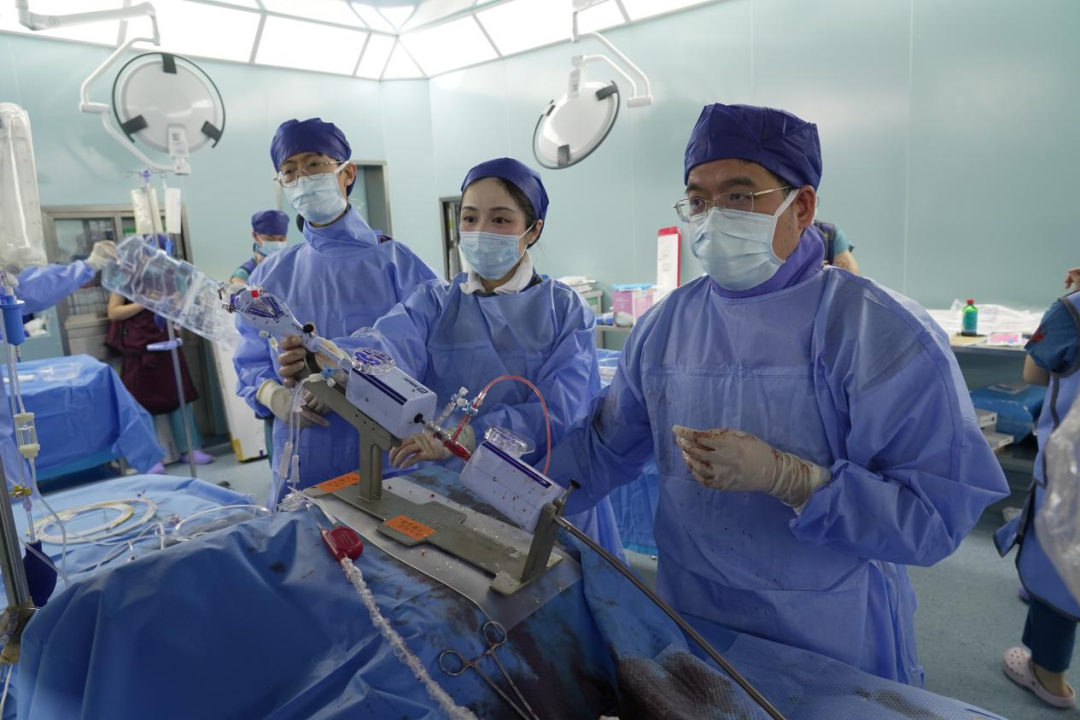
Recently, the Heart Failure Center team of Qingdao University Affiliated Rizhao Hospital / Rizhao International Heart Hospital, led by Director Gao Tingwen, in collaboration with Professor Pan Wenzhi and Professor Li Wei from Zhongshan Hospital, Fudan University, successfully performed the first-of-its-kind in China "one-stop" procedure combining transcatheter mitral valve edge-to-edge repair (TEER) with cardiac contractility modulation (CCM) implantation on a 54-year-old patient with severe heart failure. This breakthrough marks a significant advancement for our hospital in the field of combined interventional treatment for valvular heart disease and heart failure.
How Challenging Was the Patient's Condition?
The patient, a 54-year-old man, was admitted with "recurrent chest tightness and dyspnea lasting over one year." Over the past year, he had experienced chest tightness and shortness of breath upon exertion, accompanied by palpitations and fatigue, with a severely compromised quality of life. He had previously undergone coronary angiography at another hospital, which ruled out coronary artery disease. However, despite optimal medical therapy, his symptoms continued to recur. When he presented to our outpatient clinic in July, echocardiography revealed a left ventricular ejection fraction (LVEF) of only 26.39% — far below the normal range — along with global cardiac enlargement, severe mitral regurgitation, and significant regurgitation of blood back into the left atrium during cardiac contraction.
Why Was a "One-Stop" Approach Essential?
The patient faced two concurrent challenges: severely impaired myocardial contractility, compounded by structural valvular regurgitation. These two conditions are mutually reinforcing, creating a vicious cycle — valvular regurgitation increases the burden on the heart, further worsening cardiac function, while weakened myocardial contractility prevents the valve leaflets from closing fully, aggravating the degree of regurgitation.
After repeated multidisciplinary evaluation, Director Gao Tingwen's team concluded that both ends of this vicious cycle must be addressed simultaneously.
Mitral Valve Edge-to-Edge Repair (TEER): Resolving the "Most Urgent" Problem
The patient had severe mitral regurgitation with substantial blood backflow — a key driver of his recurrent heart failure and pulmonary congestion. According to the latest guidelines on valvular heart disease management, this patient was a suitable candidate for TEER. Compared with traditional open-heart surgery, TEER offers minimal trauma, faster recovery, and no need for cardiopulmonary bypass, making it the most appropriate minimally invasive treatment option for this patient.
Cardiac Contractility Modulation (CCM): Improving the Myocardium at Its Root
The patient's LVEF of only 26.39% reflected severely compromised myocardial contractile function. However, his ECG showed a narrow QRS complex (<130 ms), meaning he did not meet the indications for conventional cardiac resynchronization therapy (CRT). According to the Chinese heart failure guidelines, CCM is precisely suited to such patients — it delivers electrical stimulation during the absolute refractory period of the cardiac cycle to enhance myocardial contractility and promote reverse ventricular remodeling. In simple terms, it "gives the weakened heart a boost."
The Synergistic Advantage of "1+1>2"
Director Gao Tingwen explained that combining TEER and CCM produces a stronger synergistic effect: TEER first addresses the "most urgent" valvular regurgitation, rapidly reducing cardiac workload and improving pulmonary congestion, while CCM improves myocardial contractility at its root. Completing both procedures in a single operation not only breaks the vicious cycle but also minimizes trauma and risk for the patient.
The surgery was performed in a hybrid operating room. Director Gao Tingwen's team first completed TEER via the femoral vein, implanting two MitraClip devices; echocardiography confirmed that regurgitation was reduced from severe to trace. The access site was then changed, and the CCM lead was implanted via the subclavian vein, with the pulse generator placed in a subcutaneous pocket. The entire procedure proceeded smoothly, and the patient remained hemodynamically stable throughout.
Postoperative Recovery
The patient recovered well after surgery, with marked relief of chest tightness and shortness of breath. Orthopnea resolved, and he was able to rest comfortably in a supine position. More encouragingly, postoperative echocardiography showed that his LVEF had improved from 26.39% before the procedure to 32%. The patient was discharged uneventfully shortly thereafter.

Closing Words
Through one technological innovation after another, Qingdao University Affiliated Rizhao Hospital / Rizhao Heart Hospital has been extending the length of life for elderly, high-risk, and complex cardiac patients. Rizhao Heart Hospital remains committed to ensuring that patients can access domestically leading medical services right at their doorstep. The success of this first-ever one-stop combined CCM and mitral TEER procedure represents an important exploration by our hospital in the field of minimally invasive treatment for complex heart failure complicated by valvular disease — and it has also accumulated valuable experience for the multidisciplinary, multi-device, precision interventional management of complex heart failure nationwide.

No. 1 Linyi Road, Rizhao City, Shandong Province (Opposite the Municipal Technician College)